
The Research Department of Aquatic Biology was created
in 1982 to encourage the use of Steinhart Aquarium's
facilities by researchers. The Aquarium offers unique opportunities of
husbandry and engineering talent, live animals, and an enormous library
of aquatic animal tissues for research at the molecular level.
Many of the projects investigated by this department
have been applied rather than basic in nature. Industrial problems as
well as concerns of local, state and federal agencies have been addressed,
resulting in environmental improvements, cost-savings, and useful legislation.
Projects undertaken along with Steinhart staff during the initial phase
of the department have included: an exploration of methods for repulsion
of deep-sea eels from oil rig wellheads; an assessment of the risks of
importing exotic freshwater eels; identification of the cause of the "Sausalito
hum", an acoustic racket that disturbs houseboat owners in Marin
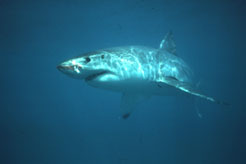
County and elsewhere; studies of white shark attack behavior, with resultant
public education that has helped to formulate public safety policies for
coastal waters and create legislation to protect that species; and, with
the Bodega Marine Laboratory, the maintenance of a population of endangered
winter-run Sacramento River Chinook salmon (Oncorhynchus tshawytscha),
increasing their number and probability for survival as well as the understanding
of maintaining genetic diversity. Other projects included: an examination
of the factors influencing the captive breeding behavior of endangered
black-footed penguins; studies of the symbol discrimination abilities
of Pacific white-sided dolphins; studies of the symbiotic relationship
of flashlight fishes and the bacteria which they house; and studies of
the growth and buoyancy control of the chambered nautilus. These studies
were performed by research associates and other outside scientists, by
students, and by Academy staff.
Since 1995, the department has had one full-time staff
member, John E. McCosker,
the first occupant of the Academy's Chair of Aquatic Biology. In the future,
as the Academy and its Steinhart Aquarium is rebuilt, the department will
have improved and integrated facilities and expanded laboratories within
which to work.
Seafood Guide - Updated November 2004
Many conservation-minded organizations are leading the charge to inform consumers about the ecological significance and consequences of their next meal. We at the California Academy of Sciences will attempt to update this list in order to keep you aware of changes in fish abundance or fishery methods. Several other notable instituions also have seafood consumer education programs and publications:
Environmental Defense Seafood Selector
National Audubon Society's Living Oceans Program
Monterey Bay Aquarium's Seafood Watch
Seafood Choices Alliance
Passionfish
Shrimp: The Devastating Delicacy
 |
 |
Nature May 15, 2003
Swordfish photographed in Sardinia, Italy, by Norbert Wu |
| |
 |
|
| |
 |
| Illegally fished Patagonian Toothfish, also known as Chilean Sea Bass. Photo courtesy Greenpeace. |
SCIENTIFIC WHALING PROGRAM WEAK ON SCIENCE - An ENN Commentary by Dr. David Suzuki, David Suzuki Foundation
Commercial whaling was banned by the IWC in 1986 when whale populations the world over crashed and public sentiment turned against whale hunts. Since then, Japan has killed more than 8,000 whales for "scientific research" and sold the meat. However, as sales have declined, the Japanese government has started promoting whale meat through product giveaways and whale cookbooks in hopes of renewing consumer interest.
WILD FISH CATCH HITS LIMITS—
Oceanic Decline Offset by Increased Fish Farming
After decades of growth, the reported global wild fish catch peaked in 2000 at 96 million tons and fell to 90 million tons in 2003, the last year for which worldwide data are available.* The catch per person dropped from an average of 17 kilograms in the late 1980s to 14 kilograms in 2003—the lowest figure since 1965.
Study: Industrial Fishing is Wiping Out Big Species: More Than 90% of Tuna, Swordfish, Other Hunters Gone
In just 50 years, commercial fishing has wiped out more than 90 percent of the big, predatory fish in the oceans, from tuna to swordfish and marlins, researchers are reporting. The study was the first to document how severely modern industrial fishing has reduced the number of fish across the world's oceans and numerous ecosystems, they said.
"You look at this data and it's overwhelming,"said Ransom Myers, a marine ecologist at Dalhousie University in Nova Scotia, one of the authors of the report in the journal Nature. "Industrial fishing has scoured the global oceans. There is no blue frontier left."
Mercury Contamination of Seafood
Mercury contamination of seafood is a persistent public health threat that poses a significant risk to children and women of child-bearing age. While some mercury is naturally occurring in the environment, activities such as coal-fired power generation and industrial processes such as battery manufacturing have redistributed the substance and created mercury compounds that are toxic even at extremely low levels of exposure. According to the US Food and Drug Administration (January 2001) women of reproductive age should not consume any swordfish, shark, tilefish or king mackerel because they contain levels of methylmercury deemed unsafe for consumption. Additionally, tuna is considered to have high levels of methylmercury. To learn more see "Mercury Dangers: Mercury, Swordfish, Sea Turtles & You" [PDF] published by the Sea Turtle Restoration Project.
Fore more on Mercury in Seafood, click here.
Good Fish, Bad Fish: A Catch to the Catch of the Day by John McCosker, PhD
In North America and Europe, except for an occasional meal of deer, duck, trout or bass, we have largely given up hunting for our food. Only from the sea do we still regularly capture our fare from nature. But two or three decades ago, we rapidly began to exceed the endowment income of this resource and are now consuming the precious capital. Today more than 70 percent of the worlds fish stocks are overfished, depleted, or worseextinctas a food resource.
Advice to Swimmers, Surfers, Kayakers & Divers Concerning Sharks in California Waters by John McCosker, PhD
The flurry of shark attacks off the Atlantic coast this summer should make us grateful that we live in California where there have been only 81 unprovoked attacks by dangerous sharks in recorded history. Those tropical shark species involved in the Atlantic attacks do not normally occur off California and it is only the white shark (Carcharodon carcharias) that concerns us. Nonetheless, should one experience an attack by a white shark, it can be a very serious and most unforgettable event.
Longlines Lure Leatherbacks Towards Extinction
The leatherback sea turtle is on the road to ruin due to humanity's love of seafood. Marine biologist Larry Crowder of Duke University says the leatherback (Dermochelys coriacea) could go extinct within 30 years if current fishing practices continue. The endangered turtle's numbers have dropped off by 90 percent in the last 20 years, mainly due to fishing practices. Longline fisheries put out miles of baited lines for tuna and swordfish, and turtles accidentally get hooked in the process. Regulating this bycatch would be extremely difficult, as the leatherback ranges from Monterey Bay to Indonesia. But Crowder says that smaller fixes, such as changing the shape of hooks, could help alleviate the problem. Read the full story in: BBC | National Geographic
The Galapagos Islands by John McCosker, PhD
Long recognized as a living laboratory of evolution, the remoteness of those mostly uninhabited islands which straddle the equator 600 miles west of Ecuador has made them a mecca for university and museum scientists. The California Academy of Sciences has sponsored and participated in numerous research expeditions to Galapagos in order to investigate and identify the unique flora and fauna. Because of the archipelago's isolation, a large portion of the plants and animals are endemic that is, they live nowhere else.