|
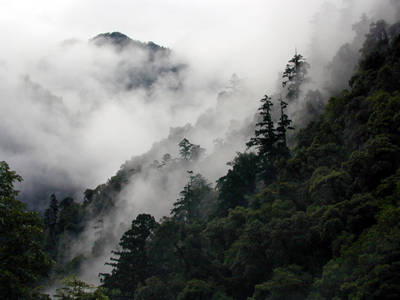
| Wispy clouds move across the forest of evergreens and tall conifers in Qiqi, China. |
Academy Expedition in China 2000
As part of a global, collaborative effort to preserve biodiversity in China, the California Academy of Sciences launched the China Natural History Project (CNHP) in May 1998. The pilot project of CNHP involved a biodiversity survey of the Gaoligong Shan region of northwestern Yunnan Province. Many new species of plants and spiders were discovered during the expedition and future scientific discoveries were promising.
In June 2000, Academy botanists, entomologists, ichthyologists, and a herpetologist and mammalogist returned to join their colleagues from Yunnan to undertake further biodiversity survey work. The international team is treading new ground in the relatively unstudied mid-elevation Dulongjiang forests of northwest Yunnan, the borderland next to Myanmar (formerly Burma). Results of the field work will be of major interest to policy-makers, conservationists, students and scholars.
Because of its concentrations of ancient and recent endemic species, it is theorized that the region of study is an isolated paleoenvironment that has remained remarkably stable through the climatological changes brought about by the Miocene collision of the Indian tectonic plate with East Asia. It is likely that dramatic mountain building caused periodic isolation of the Dulong Valley region and the creation of new niches for distinct species.
While in the field, the researchers are enjoying warm summer weather despite torrential rains, jetlag, and earthquake tremors. Before setting out into the remote terrain, the researchers studied the rich collections of wildlife belonging to the Kunming Institute of Zoology and saw specimens of animals that they are sure to see in during their field studies.
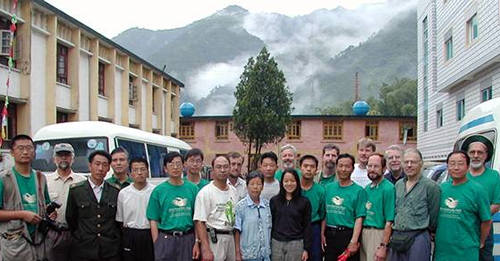 |
| Academy and Chinese scientists gather in Gongshan, China. |
Letters
From the Field
Written by Keith Howell, Academy Publications Manager
June 27
After
13 hours in a crowded plane we landed at Shanghai's enormous airport. It is
built for the next decade, and is far too large for this one. Miles of empty
lounges, stores still open despite a sparsity of customers, and a somewhat antiquated
system of checking transfer passengers--which meant it took nearly an hour to
reload the plane as the staff checked not the transfer card, or the boarding
card, but the original ticket.
By the time we arrived at Beijing it was past midnight, two days, according to the date, since the flight left. It was an eerie landing. Long, straightened, orange ribbons stretch out into the night with no other signs of life between them, or moving on them. It looked like a deserted town, with just the street lights left on. What a contrast to the next morning! Throngs of people (and bicycles) everywhere.
The weather is hot and fairly humid. The morning air as gray as San Francisco's except here it looks to be more like pollution than fog. Here, too, the afternoon's are brighter as the background to the misty photographs turns to a pale blue. Joe, Dong, and Richard Tenaza, a mammalogist from University of the Pacific are due--and then Kunming.
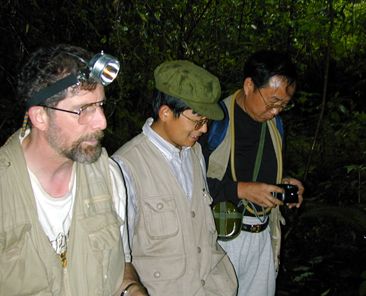 |
| Academy Entomologist Charles Griswold and Chinese colleagues Liang Hongbin and Yan Hengmei in Qiqi forest. |
June
30
In
Kunming, they say, you drown in the beauty of the clouds. We arrive through
layer upon layer of monsoon rain bearers, each one drowning us in a waterfall
of turbulence. Kunming, a provincial capital and only the 26th largest city
in the country, nevertheless has nearly 4 million inhabitants. It combines the
flavors of history with the speed and energy of a frontier. And it must vie
for the inventor of the billboard, having taken it to a new level of size and
pervasiveness. The Academy zoologists, Joe Slowinski and Dave Catania, together
with mammalogist, Richard Tenaza, an Associate from the University of the Pacific
and Carl Ferraris, Dong Lin and I arrive on schedule and are greeted warmly
by all our hosts from the Institute of Zoology (KIZ). Even the sight of the
luggage (traveling with zoologists is like accompanying Elizabeth Taylor: 20
very large pieces of luggage for 5 people) hardly dampened their enthusiasm.
Discussions the next day go equally smoothly, though we'll need a convoy of
four cars when we leave for Dali on the first leg of our trip to the mountains
later this morning--less than 48 hours after our arrival. KIZ is a neat, sparse
building, tile floors, walls undecorated, and just a solitary peacock in a glass
cage at the entrance, its tail spread in temporarily forgotten splendor. The
green peafowl, their most famous bird, is native to this region. The KIZ has
the third biggest collection of species in China and yet almost all its specimens
come from southwest China and most of them just from Yunnan province. Their
collection drawers, similar to CAS, but of wood, reveal great hornbills, golden
pheasants, silver pheasant with the brown and white herring bone patterned wings,
Lady Amherst's (?) pheasant, cranes, every hue of stunningly colored sunbirds--the
Eurasian counterpart to the hummingbirds and kingfishers. We meet Professor
Yang Lan, Professor of Ornithology and personally responsible for much of the
collection.
The mammalian pelts are kept in a room where the odor of preserving arsenic
makes the modest aromas around the Academy paltry in comparison. At first breath
it is suffocating, but worth mastering in order to explore the wealth of wildlife
that once ranged through the Chinese forests. Skins of cats--leopards, clouded
leopard, a cluster of civets, tigers, taken from poachers, stretching 10 feet,
golden cats--sun bear coats, still shiny, Asian black bear, rare deer, countless
slow loris and monkeys, macaques, gibbons, and one specimen of Semnopithecus
pileatus found in Gaoligong Mts where we're heading that's a complete sewn pelt
and the spitting image of Sesame Street's Oscar.
Kunming is having an unusually wet summer and it is always wet in summer.
July 4 - Fugong
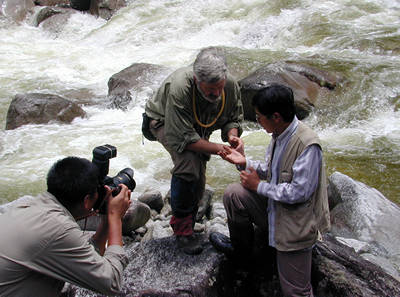 |
| David Kavanaugh with Chinese colleague, looking for carrabid beetles on the banks of the Pula River in the Gaoligong Shan. |
No sooner had the cars begin to stack up behind the lanslide, than the scattered farmers on the far bank, gathered their extra provisions—water cigarettes, fruit, cookies, and, using a cable stretched over the river harnessed themselves to a pulley and came flying over—about 200 yards.
At least one spread her arms wide, so she could enjoy flying. Another cable based higher up on the bank is used to sail back.
The restaurant, a small hotel and hot springs clinging to the side of the road, where we waited out the clean up, did not anticipate 16 travelers for lunch. They prepared what they had, and they prepared a feast.
First kill two chicken--a sharp machete to the throat. Then pluck in hot water. Living over a hot springs helps. Wash mounds of rice. Build up the fire. Then wash and wash again and again a string of Chinese sausages and a chunk of fatty pork. Bring in wood enough to keep four large pots going. Wash vegetables and add chili.
Down below the restaurant, a bloated woman’s body, caught in a eddy, floats face up arms and legs extended. It has been there some days apparently. She died from a car accident and the authorities have been informed, but they don’t appear to be that interested. It would be no easy task to retrieve it.
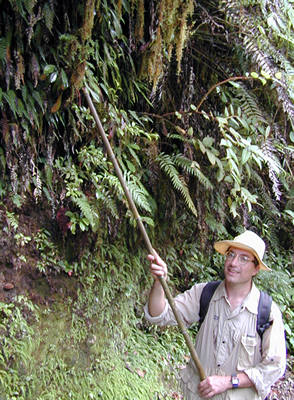 |
| Peter Fritsch points out rare plants clinging to the trailbank at 2300 meters. |
July
6
Joe Slowinski and Rau tour the local villagers and ask them to look
out for frogs, lizards, and, especially snakes. Negotiations vary between cautious
enthusiasm and apparent disinterest. We’ll see.
July
7
Entomologists visit cave some 40 km north of Gongshan. The cave itself
is small but decorated with Tibetan prayer flags, and a makeshift shrine in
the center. It’s the birthplace of the Lisu people—the major minority people
of the area. It’s a beautiful spot, but the collecting is rather poor apart
from the spiders. The botanists visit Stone Gate gorge to find an unusual palm.
July 8
Ichthyologists go down to the river Pula, a tributary of the Salween.
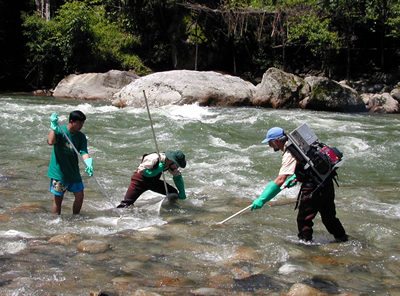
Carl Ferraris and Dave Catania climb into chest high waders, knee caps, boots and gloves, then Carl straps the electroshocker on his back holds a twometer pole in his right hand. It has a metal circle at the end about 25 cms diameter. In his left hand is a flexible metal rope. About 5 meters downstream, Dave and Chen jam large nets into the flow of the stream. Current flows more easily through suspended particles, than through clear water. But this stream has done nothing but rush seaward since its birth. It carries few organic particles. Even the rock surfaces are largely scoured clean. With the two rods only a foot or so apart, Carl cranks 700 volts to complete the circuit.
Later that day Richard Tenaza heads out of town to set shrew traps. The plan is to go beyond the cultivated areas into more natural vegetation. A difficult task at any time, but quite impossible today. Within a kilometer of town, we hit our first landslide. He manages to find some thick undergrowth on the edge of a corn crop, and hides his snares, baited with peanut butter.
As dusk descends, Joe Slowinski sets out to find a suitable frog stream: not too steep or narrow, and one that is easy to walk along. By the time he finds one, 10 kms from Gongshan, it is pouring rain. Something, in his business, you don’t even notice—except that if it’s raining so hard, even the frogs have gone for cover. Such was the case. He only caught one, caught out in the rain.
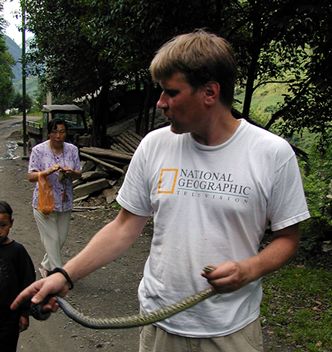 |
| Academy Herpetologist Joe Slowinski collects his first snake of the 2000 China trip--a spitting cobra. |
July 9
The Botanists and Entomologists—all told a party of 20 or so set out the
16 km walk along the side of the Pula river to the forest preserve station at
Qiqi (pronounced "chichi"). The luggage is carried by donkeys, as
is our team leader, 71 year-old Professor Li Heung who is the primary inspiration
for this whole undertaking. It has long been her dream to inventory the fauna
and flora of the Gaoligong Shan. And now with the help of scientists from around
China and the U.S., and some help from Scotland, her dream looks like it's being
realized.
She passed us a couple of hours into the journey looking rather sorry for the hikers, some of whom won’t be able to sit down, remove drenched clothes and take off soaking boots for another four or five hours of an uphill slog. But the scenery is gorgeous and we are in real, untouched forest.
July 10 - Qiqi
(Chichi)
A
forest station, deep in the Northern Gaoliganshan preserve. 20 visitors overwhelm
the facilities. But there are enough bowls and chopsticks to go round. We are
surrounded by thick forest. All three stories—the undergrowth, the shrubs, the
canopy, plus tall Taiwania conifers that reach still higher—are crowded and
healthy (and wet—over the next five days we’ll cast a shadow only once). The
botanists spend their days searching for flowering and fruiting plants and find
enough to involve them each evening in long conferences where they come to a
consensus on the species or genus in both languages and both independent nomenclatures.
The entomologists are generally more successful after dark—especially the spider guys. At night, while the fireflies dance in the trees, the headlamps of the three American and three Chinese entomologists light up the cliff faces, and the tree buttresses.
Charles Griswold is especially excited to find four spider webs, all made by different species, intertwined and active, and some never-before seen egg sacs belonging to a rare family of spiders.
And then it’s time for shala. Around the indoor fire—with no proper chimney—everyone gathers to drink a mixture bei-ju (rice wine) and the flavor of the day: pork, goat, fish. It’s heated until the alcohol catches fire and then it’s passed around in bowls for each to sip and pass on. All this is accompanied by Chinese popular songs, and some reluctant western ones.
We all get a lot fitter walking up and down these vertical slopes. And the clouds across the forested hillsides never fail to enchant.
 |
|
Ichthyologists Carl Ferraris (right), wearing an electroshocker, and Dave Catania (middle) and Chen Xiaotong (left), with the nets, look for fish in a stream along the Nujiang Valley. |
July 14 - Gongshan
Today
the botanists and entomologists hiked further and higher into the pristine forest
to Dengshaofan at 2600 meters, and 30 km west of Gongshan. In the next day or
two they hope to go over the pass into the Dulong Valley and collect on the
range’s eastern slope. Meanwhile I hiked back down from Qiqi to Gongshan and
had dinner with the Expedition’s inspiration Professor Li Heung. It was like
dining with the mayor. The whole meal was interrupted by supplicants and admirers
who came to shake her hand. She is quite a celebrity.
Meanwhile Carl Ferraris and Dave Catania, together with KIZ ichthyologists Chen Ziming and Chen Xiaotong are in Fugong 120 km south having success catching fish, albeit few species. Another 130 km south in Liuku are herpetologists and mammalogists itching to get into good forest, well the Americans anyway. Their time has not been wasted however, as they continue to acquire reptiles and amphibians from locals and a wide variety of mammal pelts from stores, many from little known species of antelope.
July 17
Pian Ma is both a frontier town and a logging town. It's a pretty tough
place with shacks, and constant building of gaudy new buildings. The logging
trucks come through from Burma half the night. We're told there's a complete
ban on logging in China, but around this town, there's little left to log. We're
going up 2,000 feet today to the forest-- about 8,000 feet. Where Richard will
set a camera trap or two and Joe Slowinski (or Pei Joe--the Chinese for beer)
will search for snakes. He already has about 400 herpetology specimens, most
collected with the help of local inhabitants. Meanwhile the Icthyologists are
in Fugong, waist deep in fast moving streams finding catfish, loaches, and suckers.
The botanists and entomologists are further north in Dengshaufan, a way station in old-growth forest some 30 km from the nearest road. They hiked in over two days along steep, rocky, muddy trails to a land that is like a moving Chinese scroll. All day wispy clouds move across the forest of evergreens and tall conifers--a constantly enchanting panoply.
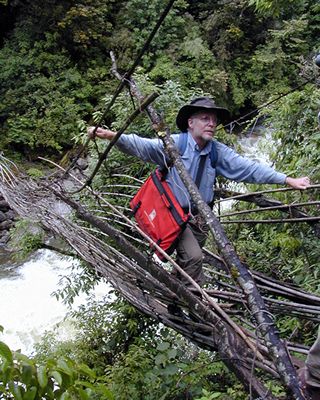 |
| Bruce Bartholomew risks life and limb on a rickety bridge, all in the name of science. |
July 19 - Pianma
There are very few roads in the Gaoligangshan. For most of the way, the
road from Liuku north to Gongshan runs along the east bank of the Salween, and
though small vehicles can just squeeze across some of the occasional bridges
in between, the rutted tracks on the far bank only accommodate one or two riverside
villages before they deadend.
The exceptions are the new Dulong Road west from Gongshan. The road only opened last year and, in part set the itinerary for this expedition. Unfortunately, the road was blocked with a severe landslide some months after it opened. The other road goes west from Liuku, for 80 kms over the mountain pass (3100 meters) and down toward Burma. At the border is the town of Pianma. This is not a town where tourists come. Non Chinese are not allowed into Burma at this point, and, though the surrounding misty mountains are beautiful, no more so than many other places. It is a logging town. At the lower elevations, the slopes lost their trees years ago. Today they come up the road from Burma on grinding, snorting trucks. The trunks are cut into about 2 meter sections—long enough to put sideways on the trucks and stripped of most of their bark. These are tropical trees. Few show the rings of seasonal growth. Much of the town consists of wooden huts built of vertical planks.They accommodate the truck drivers and other itinerant workers. Few people here are locals—or know much about the local fauna.
But Pianma does have its points, particularly if you’re collecting snakes, and you are tired of the commensalistic species, that is those, such as cobras, which do well in the shadow of humans. Our forays have produced 5 montane specimens so far, 4 different species. Though the mystery is that these species are supposed to live primarily on frogs, and we can find no frogs.
Down a 60 degree sandy slope, Richard Tenaza sets out more traps for mice, and brings back a bedraggled pair. I hope they prove worth the journey back where, sliding on the sand, for every foot gained, ten inches were lost. It was humbling, as we struggled up on hands and knees in the rain covered in wet sand, abandoning any attempt to keep dry or clean, to see Li, our guide, come alongside walking vertically, carrying an umbrella.
Later Tenaza set camera traps deep in the bamboo forest along a muntjac trail. We’ll have to see whether the animals oblige with a pose.
July 22 - LiukuLast night the herpetological hunt moved to Yaojaoping. A one dog village high on the eastern slope of the Gaoligongshan. In 1993 someone had a grand idea to build this resort. Most of the buildings—restaurant, bar, gazebo, many of the cabins have fronts of colored ornate bamboo. There is a game room, tiny cages for zoo animals, and other miscellaneous quarters. Who was meant to come here, 60 kms along a tortuous road from the nearest big town, no one knows. We
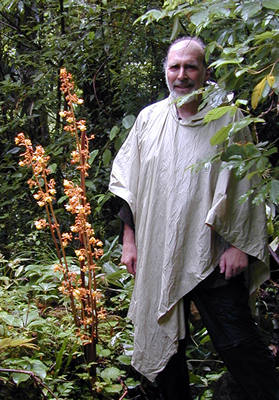 |
| Wild orchid 6' high in Goonshan Forest Reserve. Bedraggled human inserted for perspective. |
were the first overnight guests since November. The Chinese Shining. Business primarily consists of filling the water tanks, and cooling the brakes and gas tanks of the overheated logging trucks. Lunch and breakfast consisted of ready-packaged ramen, the single option in the store. We brought dinner with us.
A few snakes showed up, a lizard and frog or two, There are especially high hopes for an unusual small frog that lives in waterfalls and was caught by a local villager. Now we are waiting to see if another can be found.
Tomorrow both teams, apart from the mammalogists still in Pianma, should all be gathered in Liuku, many on their way back east.
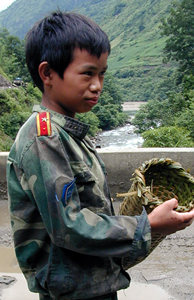 |
| Local fisherman holding his bamboo fishing trap which he strategically places in the river. |
July 25 - Liuku
Well
we didn’t leave here yesterday as planned. The Nujiang, the Angry River is not
finished with us. An enormous landslide between here and Fugong has now held
up traffic, including the KIB group, for three days. Some of the CAS staff plane
reservations are in serious jeopardy. The road is open today we’re told and,
with an early start, we should reach Xiaguan today, and Kunming tomorrow. It
won’t leave much time for sorting specimens.
The KIB group should be used to long days. Eight of them got down to the Dulong River, a three day walk each way from Gongshan—including one 14 hour marathon—plus climbing nearly 6,000', probably much of it in the rain. They should be pretty fit—and slim.
Meanwhile the mammalogists are still setting traps for rodents in Pianma, the ichthyologists are systematically inventorying the streams around Liuku. (as the current of the Nujiang has subsided a little, they are also able to find quiet stretches of the main river where they can stand up against the flow), the herpetologists are anxiously awaiting Dong Lin who has been traveling with KIB and is due to switch back. Joe Slowinski has some beautiful snakes to photograph.
July 26 - Kunming
The landslide
finally released its victims at one o’clock, after 2 days delay. (They arrived
15 minutes before I was going to take the commercial bus. It would have been
faster.) There was no time to overnight in Liuku. Just a late lunch and back
on the road by 4:30.
Just outside Liuku there is a prefecture crossing—one they take seriously for foreigners, despite the presence of all the Preserve officials gathered there to say goodbye.
An hour later we had our first breakdown. It’s hard and expensive to get a driver’s license in this country, and I imagine one of the requirements, at least for a commercial license is being able to fix your vehicle. Three drivers poured over a steaming oily engine. Eventually they handcrafted some water hose and hiked off to fill the radiator. Half an hour later we were on the road again.
On the flight from Beijing to Kunming a month earlier it was clear that China was a mountainous country. Now that we had 7 mountain ranges to cross in an underpowered, overheated bus it became all too apparent. And the first two were climbing out of the Nujiang Valley and, 50 kms later, the Mekong Valley. We managed those two with only one more stop for water.
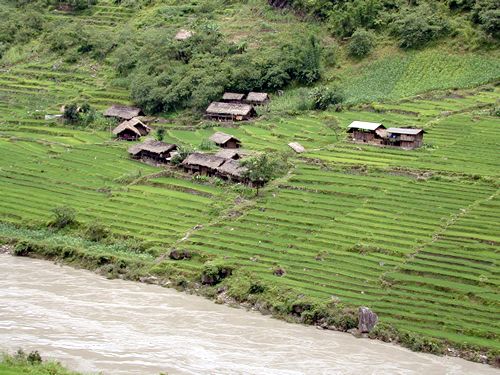 |
| Rice terraces beside the Nujian River. |
We, that is the American "we," had been told we would spend the night at Yongping, a dot on the map no one had noticed on the way over. It turned out that the main road didn’t go through the town. The main boulevard, 120 meters wide with trees planted down the center and gaudy hotel round the edge was a shock. I doubt any of it could have been there two years ago. And some of it wasn’t there yet. When we finally found a hotel with accommodation, we had to drive a quarter mile up the boulevard where Every building—including many very fancy ones—was under construction. By next year the town will be unrecognizable again.
But the rush was still on. Six hours sleep, and we were on the road again. Sort of. 10 minutes from the hotel and the drivers were back into town to buy some new hose. Five arduous mountain passes and several stops to tighten the oil filter and such, and we arrived at the Kunming restaurant where CAS was hosted a farewell dinner.
Meanwhile, the ichthyologists are still sampling Liuku’s rivers, Slowinski finally has Dong Lin to photograph the colorful snakes he has captured before visiting the local snake market and going back into the field to find rare frogs. The mammalogists should be leaving Pianma today. I wonder what they found?
Kunming is located in the Yunnan Province approximately 200 miles north of the China-Laos-Viet Nam border.
 |
 |