
|
|
Karen Cebra, Collections Manager, Department of Ornithology and Mammalogy
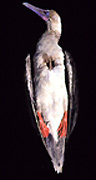 The Academy's collection of bird skins contains 85,000 specimens
from around the world. For the most part, any one specimen represents
a common species for the particular region in which it was collected.
On occasion, though, one can find some quite interesting rarities.
For example, the Academy's collection contains a Red-footed Booby
(Sula sula) collected just south of San Francisco. This is
quite a bit north of its normal range in the tropical ocean regions.
There exist only a handful of sightings of the Red-footed Booby along
California's coastline, and the Academy's specimen may be the only
one actually collected from the state of California. This particular
bird was found dead on the beach in 1994 and may have been blown off
course by a storm at sea.
The Academy's collection of bird skins contains 85,000 specimens
from around the world. For the most part, any one specimen represents
a common species for the particular region in which it was collected.
On occasion, though, one can find some quite interesting rarities.
For example, the Academy's collection contains a Red-footed Booby
(Sula sula) collected just south of San Francisco. This is
quite a bit north of its normal range in the tropical ocean regions.
There exist only a handful of sightings of the Red-footed Booby along
California's coastline, and the Academy's specimen may be the only
one actually collected from the state of California. This particular
bird was found dead on the beach in 1994 and may have been blown off
course by a storm at sea.
Boobies are seabirds which nest colonially on islands. The Red-footed Booby is the smallest of the six existing species, weighing between approximately 1.9 and 2.4 pounds and having a wingspan of 36-40 inches. It feeds mostly by diving into the water for flying fish and squid, singly or in groups. It generally nests in trees. A pair of boobies will raise one chick each year.
Although females are larger than males on average, they are not readily distinguishable from them in their plumage characteristics. During breeding season, the male does develop a greenish patch by the eye, but it quickly fades once incubation commences. The Red-footed Booby is somewhat unique among seabirds in that it displays a variety of color morphs or phases. Just like humans can have brown, blond, black, or red hair, a Red-footed Booby can be mostly white, mostly brown, brown with a white tail, or brown with a white tail and head. Juveniles can be distinguished from adults by bill color and streaked plumage at fledging. The adults of all color phases have spectacular red feet.
Many things are left to be discovered about these birds. How long do they live? What are individuals doing between the time they fledge and the time they return to their natal colonies as adults? What are the specific effects of human activity on their populations? The more we are able to understand, the better we will be able to conserve and manage this unique species of seabird.
California Academy of Sciences - Department of Ornithology and Mammalogy
Wildlife - Marine World - Boobies
Return to People, Places and Things
Return to the Research Home Page of the California Academy of Sciences.
 California Academy of Sciences, Golden Gate Park, San
Francisco, California
California Academy of Sciences, Golden Gate Park, San
Francisco, California